ecozy Lumo Lite E60A Review: Flexible Sunrise, One Important Power Limit
Exact-Model Documentation Review
The E60A combines a 0–60-minute sunrise, 22 wake sounds, a separate 26-track sleep library, optional Bluetooth playback and physical controls. It works without an app, but its coin cell remembers settings rather than operating the alarm during an outage.
Bottom line
Choose it for a locally controlled light-and-sound routine with unusually broad timing and snooze adjustments. Skip it when two independently documented alarms, app scheduling, battery operation or measured light and sound performance is essential.
Desk-researched from the exact Ecozy product page, exact-model manual, official support page and Amazon retail entity. No hands-on use, laboratory result, medical outcome, current price or universal wake guarantee is implied.
Exact retail entity
ecozy Lumo Lite E60AMatch model AC-SCE60A, Ecozy SKU EY-AC-SCE60A-USWH0 and Amazon ASIN B0DRW6TWXS before ordering.View on AmazonCritical boundary
Memory backup is not alarm powerThe CR2032 cell preserves settings. The clock needs its 5V/2A supply for the display, light, speaker and scheduled wake event.Check the power pathCompare the requirement
Sunrise alarm clocksCompare light timing, schedule capacity, control burden, audio roles and outage behavior across current models.Open the buying guideQuick Verdict
Broad Local Control, but No Alarm During an Outage
The ecozy Lumo Lite E60A is a practical match for someone who wants a sunrise alarm, a sound machine and colored bedside light without making a phone app part of the morning. Its exact manual documents unusually wide local adjustments: the sunrise can start from zero to 60 minutes before the alarm, the wake-light endpoint can be set from off through 20 steps, and the alarm can use one of 22 built-in sounds across 16 volume levels. Daily, weekday and weekend repeat choices cover a conventional work schedule without editing the clock every night.
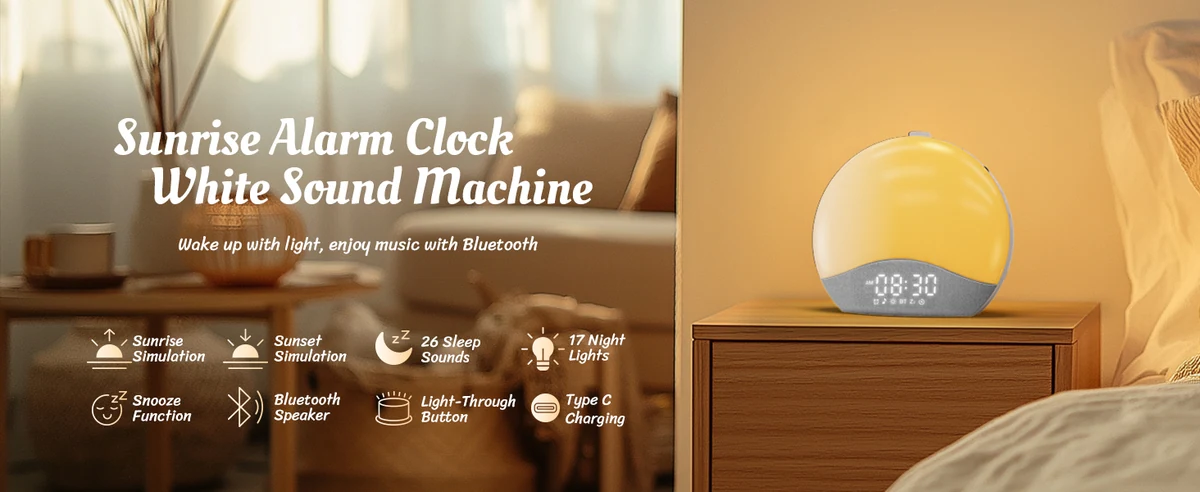
The strongest reason to consider it is not the number printed on the feature graphic. It is the way the separate controls can be combined. A light-sensitive sleeper can begin with a longer, lower sunrise and retain sound as the deadline. Someone who dislikes light before waking can set the lead time to zero or turn the wake light off and use a built-in sound. The snooze interval is adjustable from five to 20 minutes, and the manual lets the owner decide whether light remains on during snooze. Those are meaningful behavior choices, not decorative extras.
The E60A also separates nighttime audio from morning audio more clearly than its advertising first suggests. The alarm library contains 22 wake sounds. The sound-machine library contains 11 noise choices plus 15 nature sounds or songs, making 26 sleep tracks. Bluetooth adds ordinary speaker playback and can calibrate the clock time when a phone connects. The manual does not say that a Bluetooth stream or all 26 sleep tracks can become the scheduled wake source. A buyer who wants to wake to a personal playlist should therefore choose a product that documents that function explicitly.
Two limits decide whether the E60A is safe for the intended routine. First, the CR2032 cell is settings memory, not operating power. During a mains failure the clock cannot be treated as a working battery alarm. Second, Ecozy's short support FAQ uses the phrase “multiple alarms,” while the exact manual provides one alarm-setting sequence and does not explain two independent banks. This page follows the detailed manual. One recurring wake schedule is documented; a second separately armed time is not promised.
Choose the E60A when one local schedule, adjustable light, built-in sound and a fully dark display meet the requirement. Choose another clock when two people need different alarms, a shift schedule changes by day, an app must manage routines, or the alarm has to survive a power cut. Brightness and loudness are also unmeasured: 20 light steps and 16 volume steps describe control positions, not lux or decibels. A demanding sleeper should rehearse the exact unit while keeping a proven second alarm active.
Buy it if
- You want a sunrise alarm with no required account, Wi-Fi or app
- A 0–60-minute light lead and 20 endpoint levels fit the routine
- One daily, weekday or weekend schedule is enough
- Adjustable five-to-20-minute snooze behavior matters
- A display that can switch completely off is important
- Built-in sleep audio and optional Bluetooth playback reduce nightstand clutter
Skip it if
- The alarm must sound when mains power fails
- You need two independently documented wake times
- You want app scheduling or a streamed song as the alarm
- You require verified lux, decibel or clinical-light performance
- You need a battery-powered travel alarm
- A published long-term software or repair policy is essential
Exact Model Boundary
Match the Lumo Lite E60A by Model, SKU and ASIN
This review covers the ecozy Lumo Lite E60A identified in the instruction manual as model AC-SCE60A. Ecozy's current store record uses SKU EY-AC-SCE60A-USWH0, and the manufacturer's Buy on Amazon endpoint maps that product to Amazon.com ASIN B0DRW6TWXS. Those identifiers matter because a search for “ecozy sunrise alarm clock” can return neighboring designs, older imagery, bundled variations and unrelated clocks that use similar round lamps.
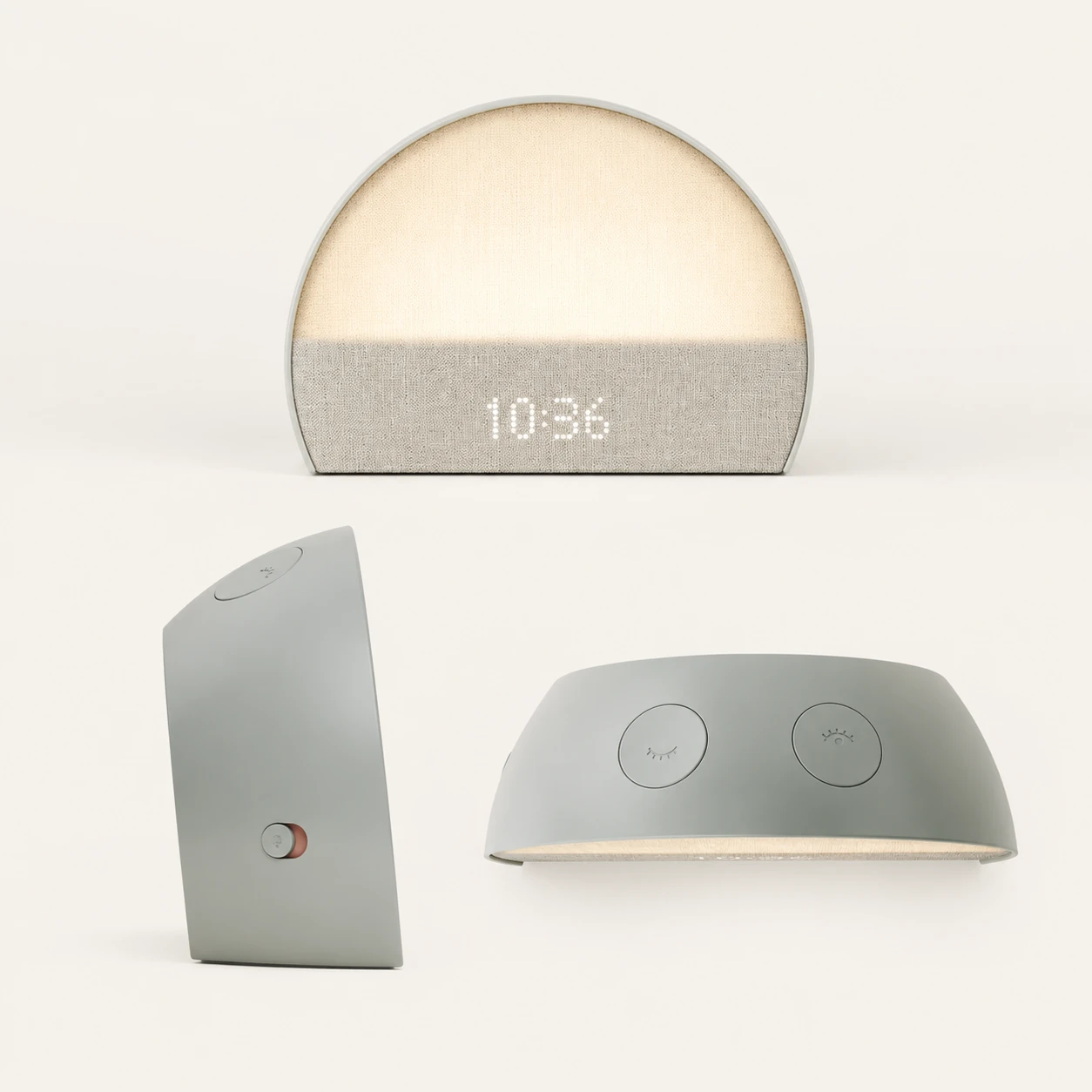
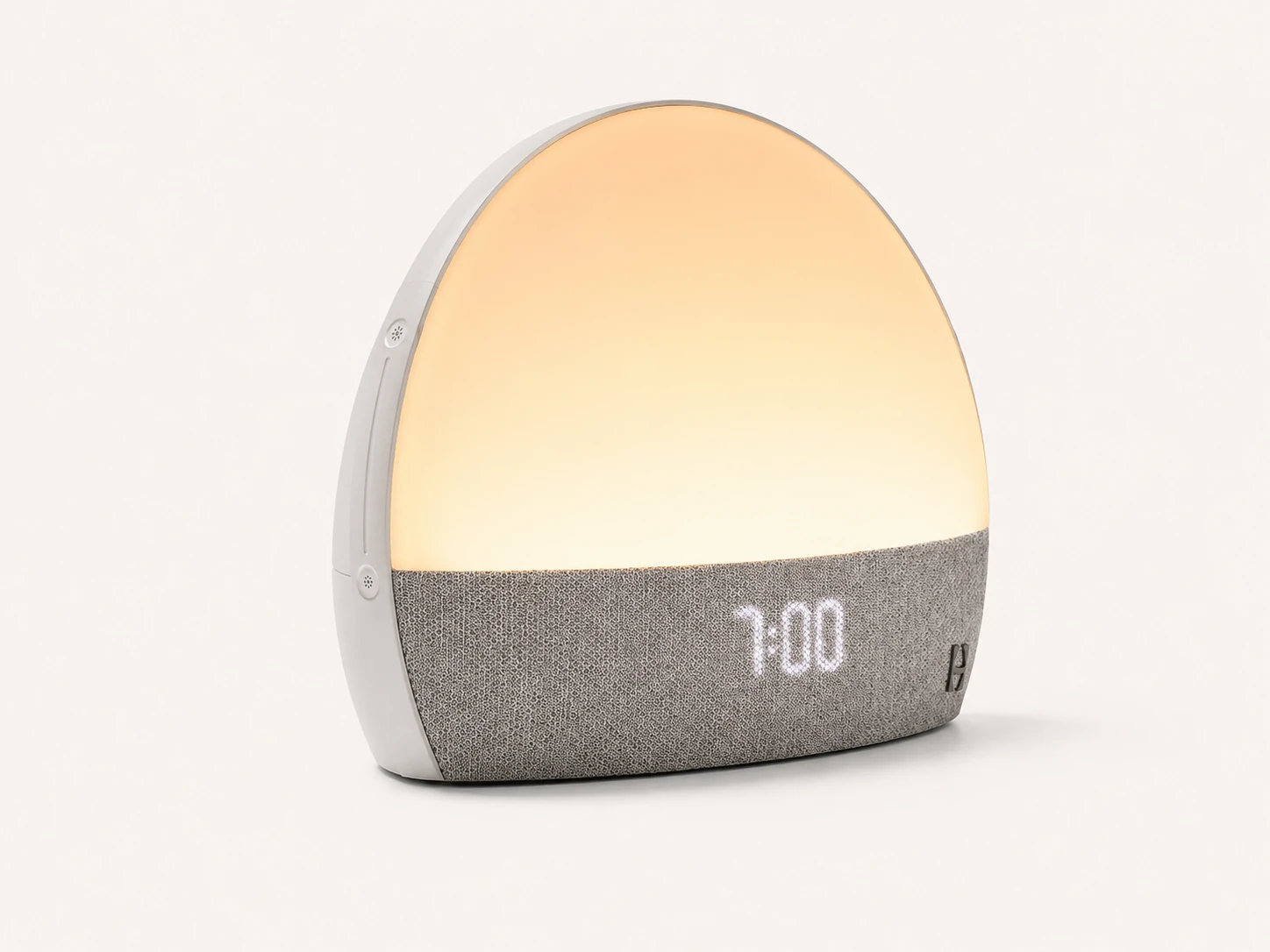
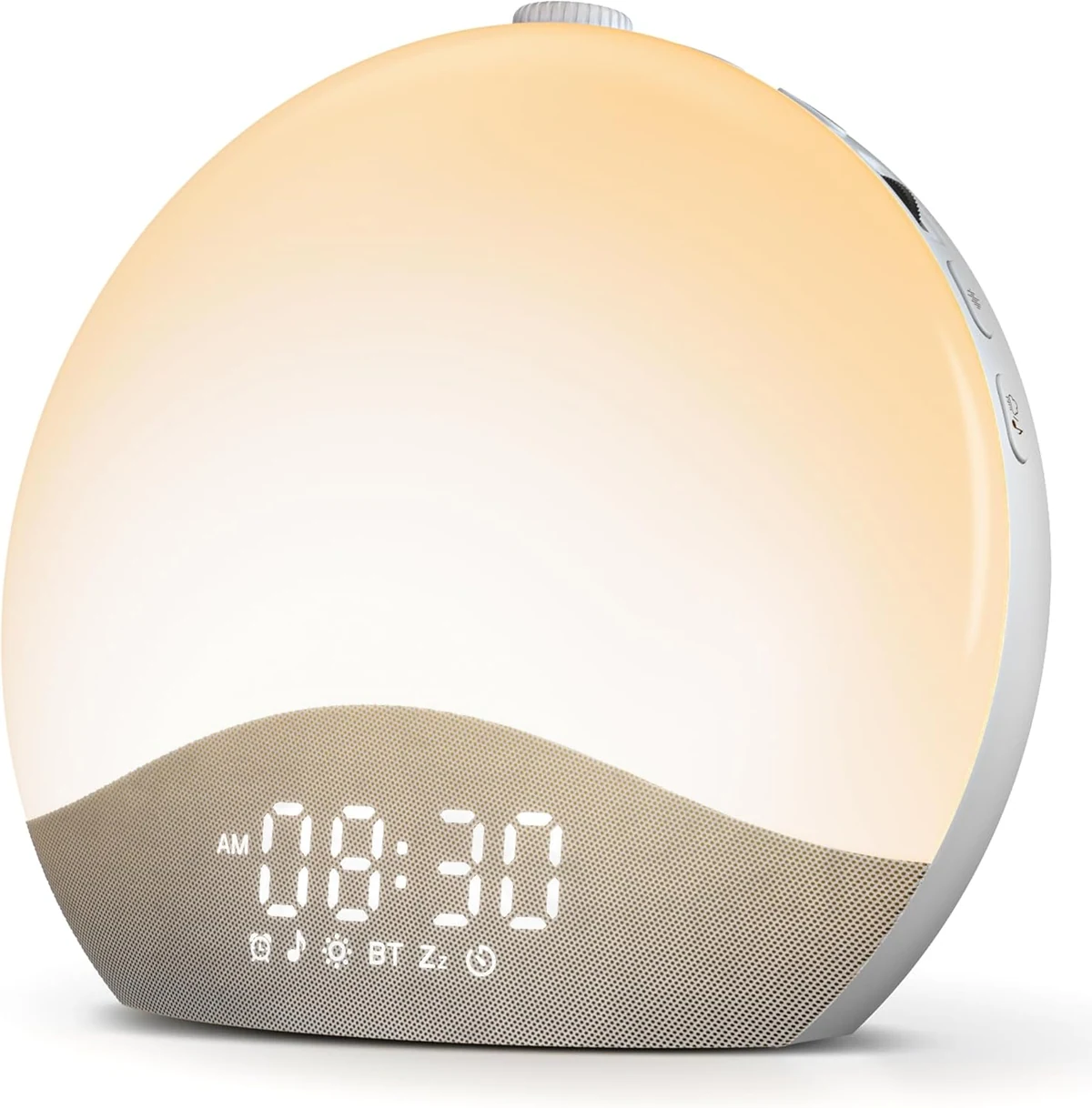
The exact device has a large circular light above a fabric-covered lower front, a digital display within that lower section, and physical controls on the case. Its manual lists a 5V/2A input, a USB output, a CR2032 settings battery and dimensions of 7.1 by 6.3 by 3.1 inches. A listing with a different shell, app requirement, alarm count, port layout or model number should not inherit the E60A's instructions merely because the product photograph looks close.
Retail color labels deserve a smaller caution. The exact Amazon child record is labeled Gray, while Ecozy's internal SKU ends in USWH0 and the product photographs show a pale body with a gray fabric face. Color naming can vary between catalog systems. The stronger match is the combination of model AC-SCE60A, ASIN B0DRW6TWXS, control layout and included power arrangement. Confirm those points before using this review as a setup reference.
Research for this page was checked on September 3, 2026. Price, coupon, seller, delivery date, star rating and inventory are deliberately excluded from stable claims because they can change while the device remains the same. The Amazon button is a route to the exact retail entity, not evidence that a particular offer, package or return window will remain available.
| Check | Included here | Do not assume |
|---|---|---|
| Model | AC-SCE60A / Lumo Lite E60A | Any visually similar Ecozy or generic round wake light |
| Ecozy SKU | EY-AC-SCE60A-USWH0 | A neighboring regional or bundled SKU |
| Amazon entity | B0DRW6TWXS, Gray child listing | Features from another child ASIN |
| Evidence | Exact manual, official product and support pages | Hands-on, laboratory or long-term ownership results |
Setup and Controls
Physical Controls Avoid an App but Still Need a Daytime Rehearsal
The E60A is app-free in the sense that its clock, alarm, light, sleep audio and timer can be configured on the device. That removes account creation, cloud availability and Wi-Fi credentials from the core wake path. It does not make the interface self-explanatory. Several buttons change purpose when tapped, held or used while another mode is active, so the safest setup happens during the day with the manual open and a test alarm only a few minutes ahead.
Begin with the supplied power arrangement. Ecozy's support page warns that the clock should be connected to power for first use and that the included adapter should be used. Set the time, then walk through the alarm sequence in order: alarm time, repeat pattern, wake sound, volume, sunrise lead, wake-light level, snooze duration and whether the light remains active during snooze. Do not stop after the display shows the desired time. Confirm the alarm indicator that proves the schedule is armed.
Bluetooth is optional, but its time-calibration behavior can be useful. The manual identifies the speaker as E60A and states that connecting a phone calibrates the clock time. That is not the same as app scheduling or continuous network time. After pairing, disconnect the phone and verify that the saved alarm still arms, sounds and stops from the physical controls. The normal morning must not depend on remembering which audio mode was last active.
A bedside interface should also be judged from the pillow, not only while standing over it. Rehearse the top control, snooze and alarm stop in a dim room. Learn the difference between silencing today's event and disabling the repeating schedule. If another person shares the bed, have that person observe the chosen display and light levels. A setting that looks subtle in daylight may be intrusive after dark.
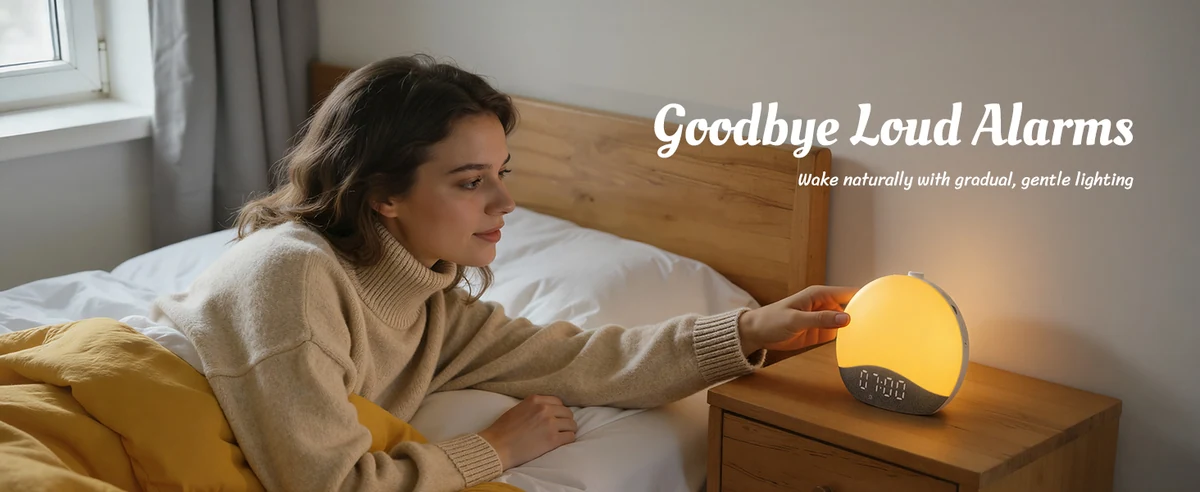
Sunrise Light
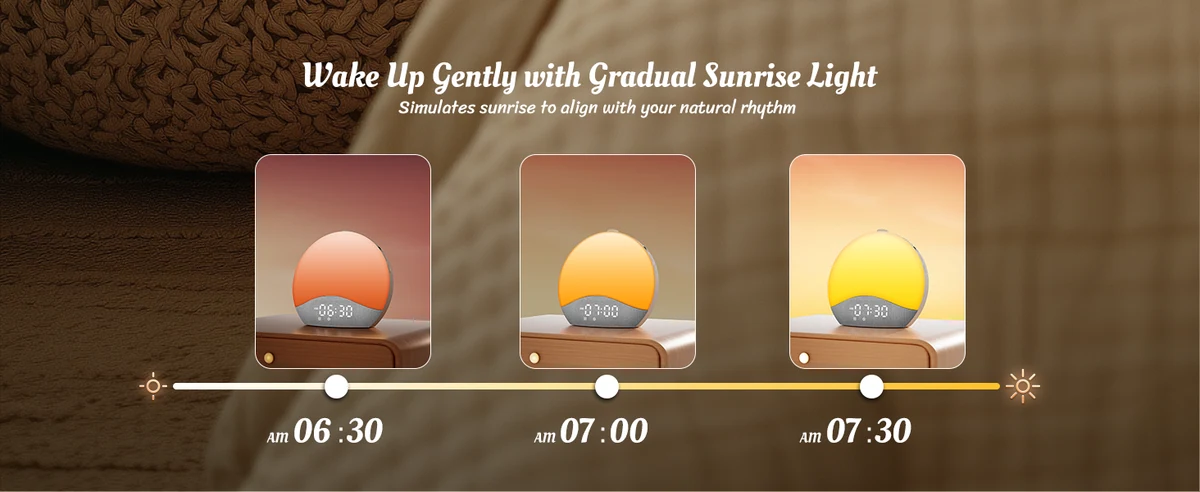
The 0–60-Minute Sunrise Is Flexible, but Output Is Not Measured
The E60A manual allows the sunrise to begin from zero to 60 minutes before the alarm. Zero is an important choice: it removes the pre-alarm lead rather than forcing every user through a long ramp. At the other end, 60 minutes gives a light-sensitive sleeper more time to encounter the changing room before the audible alarm. The wake-light endpoint can be turned off or set from L01 through L20, which means sound-only, light-led and combined routines are all possible.
Those numbers describe settings, not performance. Ecozy does not publish a verified pillow-level lux reading, calibrated color-temperature path or room-size result for the exact model in the sources reviewed. Twenty levels do not prove that level ten is half as bright as level twenty, and a 60-minute program does not prove that every intermediate change is equally smooth. Bed distance, orientation, wall color, bedding, season and whether the sleeper faces the lamp all change the amount of light reaching the eyes.
The useful setup method is incremental. Start with a moderate lead and endpoint, keep the built-in sound active as a deadline, and change only one variable after several ordinary mornings. If the light wakes a partner too early, first move or rotate the clock before shortening the entire sequence. If the sleeper notices only the final bright stage, bring the light into the line of sight or extend the lead before concluding that more headline brightness is required.
Ecozy's support page describes a bedtime “reverse sunrise.” The available exact manual explains a sleep timer that can stop light and audio, but it does not provide a complete, unambiguous reverse-ramp programming sequence. That gap should affect the purchase only if a gradual sunset is essential. Treat the marketed sunset behavior as a feature to verify on the delivered revision, not as a setup path that this review can safely invent.
Alarm Schedule and Snooze
One Documented Alarm Path Covers Three Repeat Patterns
The exact manual documents one alarm-setting workflow with repeat options for every day, weekdays or weekends. That is enough for a person with one stable wake time and a conventional five-day workweek. It is less suitable for two sleepers, alternating shifts, split custody or days that need different times. Ecozy's support FAQ says “multiple alarms,” but it does not show the names, indicators or steps for two independent alarm banks. Until exact-revision documentation does, a second wake time is an unknown rather than a selling point.
Sound selection is much clearer. The alarm list runs from S01 to S22, while volume runs from V01 to V16. The sunrise endpoint can also be off, and the manual's workflow lets the owner decide how much of the wake event is light and how much is sound. The count does not reveal which sound is most effective, how sharply it begins, whether it loops seamlessly or how loud V16 is at the pillow. Those are receipt checks.
Snooze is unusually configurable for this class. The duration can be set from five to 20 minutes, and the light can remain on or switch off during snooze. The manual does not state a maximum number of snoozes, so the delivered behavior needs checking rather than being described as unlimited. Repeated snoozing can still turn one alarm into a long, inconsistent wake window. Choose the duration deliberately and place an independent alarm across the room if repeated snoozing has already caused missed commitments.
If nobody intervenes, the alarm stops after 30 minutes. Automatic stop protects the room from an alarm that rings indefinitely after the sleeper leaves; it is not proof that the sleeper woke. On a critical morning, set a short daytime trial using the same volume, sound, sunrise, snooze-light choice and placement planned for the real event. Keep a second proven alarm until the full routine works consistently.
| Setting | Documented choice | Buying meaning |
|---|---|---|
| Repeat | Every day, weekdays or weekends | Good for one conventional schedule; not a custom seven-day calendar |
| Wake sound | S01–S22 | Separate from the 26-track sleep library |
| Volume | V01–V16 | A control scale, not a published decibel result |
| Snooze | 5–20 minutes; light on or off | Useful flexibility that needs a deliberate rule |
| Automatic stop | 30 minutes | A timeout, not a wake-success guarantee |
Sleep Audio and Bluetooth
Twenty-Two Wake Sounds and Twenty-Six Sleep Tracks Are Separate Libraries
The E60A has three audio roles that should not be collapsed into one feature count. The scheduled alarm chooses from 22 wake sounds. The sound-machine mode offers 11 noise choices plus 15 nature sounds or songs, for 26 bedtime tracks. Bluetooth lets the unit play audio supplied by another device. The manual documents these as separate paths, and nothing reviewed establishes that a Bluetooth song or every sleep track can be selected as the scheduled alarm.
That distinction prevents a common buying mistake. “Bluetooth speaker” can sound like wake-to-playlist support, but it describes playback while a phone is connected. It adds phone battery, pairing state, notification settings and app behavior to the audio session. Built-in alarm sounds remain the clearer wake path because they live on the clock and are selected inside the alarm workflow. Use Bluetooth for optional listening unless the delivered manual explicitly documents more.
The 26-track sleep library offers variety, but it does not establish recording quality. The exact sources do not publish speaker response, maximum sound pressure, loop length, gap behavior or noise-floor measurements. A rain track that masks traffic for one room may draw attention in another. During the return period, listen to the intended track at the intended volume for longer than one loop and from the normal pillow position. Check whether the lowest useful level is quiet enough for a partner.
Bluetooth pairing to the device name E60A also calibrates the clock time according to the manual. That can correct drift without turning the alarm into an app-dependent product. Test the boundary: connect once, confirm the displayed time, disconnect the phone, set a near-term alarm and verify that the clock completes the wake event locally. If the ordinary alarm still works, Bluetooth remains a convenience rather than a hidden morning dependency.

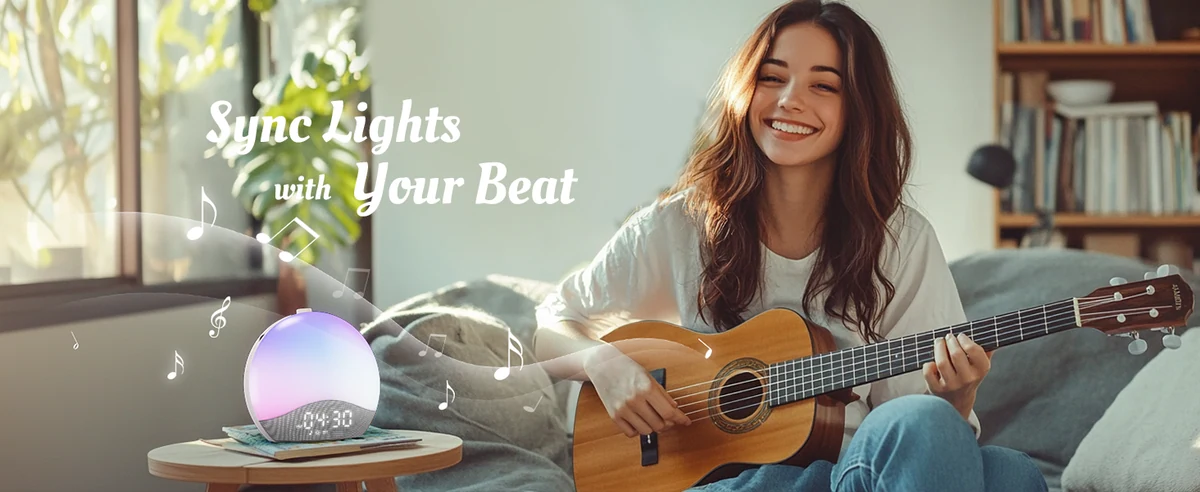
Display and Ambient Light
Display-Off, Reading Light and RGB Modes Need Separate Choices
The clock display has five documented states: high, medium, low, very low and off. That final setting is valuable in a dark bedroom because it removes the illuminated digits rather than merely making them faint. Display-off should still be verified alongside the alarm indicator and wake light. Turning the time display off is not the same action as disabling the sunrise or ambient lamp, and the owner needs to know which state remains visible after an alarm is stopped.
The lamp system serves more than the sunrise. The manual names eight fixed colors and an RGB mode family, while Ecozy markets 17 lighting choices in total. It does not provide a reliable one-to-one map that justifies inventing names for all 17. One RGB mode can react to Bluetooth audio. Treat that as an ambient effect; it does not show that the sunrise uses 17 calibrated stages or that every color is available inside the alarm program.
For a shared bedroom, the decision is less about total colors than about unwanted light. Set the time display to off, select the lowest usable night-light level and observe the room after the eyes adapt. Check walls and mirrors that can reflect the lamp toward the other pillow. If a child uses the colored light, establish one simple bedtime state and rehearse how to return to it after experimenting with dynamic modes.
A reading or mood light can replace a second bedside lamp only if its direction and lowest practical level fit the room. The E60A's broad circular diffuser throws light differently from a narrow task lamp. It may be more comfortable for ambient use but less precise for reading without disturbing a partner. No published beam or lux measurement resolves that question; placement does.

Sleep Timer
The Sleep Timer Covers a Short Wind-Down or a Full Night
The documented timer choices run from 10 to 120 minutes and then continue through 180, 240, 300, 360, 420 and 480 minutes. That range supports two different jobs. A short timer can accompany reading or a brief wind-down; the eight-hour endpoint can keep a built-in masking sound active for most of a night. Choose the job first, because an eight-hour audio session and a 30-minute bedtime cue have different volume and partner-impact requirements.
The timer can end light and audio, but it should not be confused with a confirmed gradual sunset. Ecozy's support copy mentions reverse sunrise, whereas the exact manual available for this review does not set out a complete reverse-dimming sequence. A timed shutoff is documented. A specific smooth reverse ramp remains something to verify on the received unit.
For overnight masking, test the track beyond its first minutes. Listen for loop boundaries, tonal changes and a volume that stays useful without dominating the room. Then confirm what the display shows when the timer ends and whether the scheduled morning alarm remains armed. Night audio is helpful only when its stop behavior does not create a new morning uncertainty.
Power, Backup and Charging
Mains Power, Memory Backup and USB Charging Solve Different Problems
The E60A is a mains-powered bedside clock. Its manual specifies a 5V/2A input, and Ecozy's support page tells owners to use the included adapter. The adapter label states 100–240V, 50Hz. That marking alone does not establish compatibility with every electrical region: frequency, plug type and local requirements still need checking. The clock remains mains-dependent and is not a battery travel clock.
The CR2032 coin cell preserves settings. It is not documented to keep the display visible, light running, Bluetooth playing or alarm sounding during a power failure. This is the most important safety boundary on the page because the phrase “backup battery” often suggests more than it delivers. Treat the cell as memory backup only. If waking through an outage is nonnegotiable, add a separately verified battery-operated alarm or choose a model whose manual explicitly documents full alarm operation on backup power.
The USB output can charge another device and may remove one adapter from the nightstand. The reviewed sources do not establish a fast-charge standard or high-wattage output, so it should be treated as convenience charging. A phone drawing power from the clock does not provide power back to the clock, and a charged phone is not an automatic backup unless its own alarm is deliberately set, audible and permitted through focus or do-not-disturb settings.
Power-path rehearsal is simple and should happen before an important morning. Photograph the saved settings, disconnect mains briefly during the day, reconnect it, and verify time, alarm, repeat pattern, sound, volume, sunrise and snooze behavior. Do not expect the alarm to operate while unplugged. The purpose is to learn what memory survives and how quickly the unit returns to a trustworthy state.
| Feature | Documented role | Not established |
|---|---|---|
| 5V/2A input | Operating power for the clock | Portable operation without a supply |
| CR2032 cell | Preserves settings | Display, light or alarm operation in an outage |
| Adapter label | 100–240V, 50Hz input marking | Compatibility with every destination, frequency or outlet |
| USB output | Convenience charging for another device | A verified fast-charge protocol |
Scenarios and Fit
Bedroom Scenarios Show Who the E60A Fits
For one regular work schedule: the E60A is straightforward. Select weekdays, choose a sunrise lead and retain sound as the deadline. Weekend is an alternative repeat mode for the same saved alarm, not a second simultaneously armed schedule. Someone who needs a different weekend time should therefore choose a documented dual-alarm model or confirm that capability on the delivered revision before relying on it.
For a dark bedroom: the display-off state is a real advantage. It removes the clock digits while leaving the alarm schedule available. The owner still needs to switch off or lower any ambient light separately. A blacked-out display also makes state confirmation harder from bed, so learn the alarm indicator and buttons before relying on touch alone.
For a couple: the light is shared even when only one person sets the alarm. A longer sunrise can disturb the earlier light-sensitive partner; repeated snooze can extend that disturbance. Use orientation and the snooze-light option before reducing the alarm to sound only. When two different wake times are required, a documented dual-alarm model such as the Philips HF3520/60 is the clearer comparison.
For a heavy sleeper: the combination of light and sound may be more useful than either alone, but the exact sources publish no maximum dB or pillow-level lux. The E60A should not be selected from the phrase “wake-up light” alone. Rehearse it with a proven second alarm. If vibration or independently measured loudness is required, use the alarm clocks for heavy sleepers guide instead of stretching this product beyond its evidence.
For a child or family room: physical controls, colored light and built-in sleep sounds can support a routine without an account. The adult still needs to keep the control pattern simple and verify volume. A lamp with attractive RGB modes can invite late-night experimentation; one saved bedtime state is more useful than cycling through every mode.
For travel: the adapter is marked 100–240V, 50Hz, but that label alone does not confirm compatibility with every destination, frequency or plug. The body measures about 7.1 by 6.3 by 3.1 inches and weighs 450 grams, and the clock must remain connected to power. It can move between compatible outlets, but it is not a compact battery alarm for a suitcase or hotel power uncertainty. Keep a phone or small battery clock as the independent route.
For seasonal mood concerns: a pleasant morning cue is not the same as a medically specified light-therapy device. The sources provide no therapeutic illuminance, treatment distance, ultraviolet statement or clinical protocol. Use the E60A as a consumer sunrise alarm and ask a qualified professional about symptoms or light-therapy needs.
Acceptance Check
Verify the Exact Clock Before an Important Morning
A product page cannot tell whether this exact light, sound and control pattern works in a particular bedroom. The safest decision ends with a short acceptance test while the return window is open. Keep the packaging and supplied guide until the clock has completed the full routine, including a controlled power interruption.
- Match the entity. Confirm Ecozy Lumo Lite E60A, model AC-SCE60A, the expected control layout and, when bought through Amazon, ASIN B0DRW6TWXS.
- Use the documented supply. Connect the included adapter and inspect the clock for stable display, light and sound operation.
- Set trustworthy time. Set it manually, then optionally pair Bluetooth to E60A and observe the documented time calibration. Disconnect the phone afterward.
- Create a five-minute alarm. Choose the intended repeat mode, sound, volume, sunrise lead and light endpoint. Verify the armed indicator.
- Watch the complete sequence. Confirm when light begins, when sound begins, how the top control behaves and whether stopping today leaves the repeating schedule armed.
- Test snooze once. Use the chosen five-to-20-minute interval and verify whether light remains on or switches off as selected.
- Darken the room. Switch the time display off, set any night light deliberately and check glare or reflections from both pillow positions.
- Separate the audio modes. Play one built-in sleep track and one Bluetooth source, then return to the alarm screen and confirm the scheduled wake sound has not changed.
- Check settings memory. Disconnect mains briefly during the day. Do not expect the alarm to run. Reconnect and verify every critical setting.
- Keep a second alarm. Use an independent proven device for several mornings and whenever the cost of oversleeping is high.
Record the final wake time, repeat pattern, sunrise lead, light level, sound number, volume, snooze duration and snooze-light state. That small note is more useful than remembering a menu path under pressure. It also makes recovery faster after travel, a battery change or an accidental reset.
Specifications
ecozy E60A Specifications and Evidence Limits
| Specification | Source-backed value | Decision meaning |
|---|---|---|
| Exact entity | Lumo Lite E60A; AC-SCE60A; SKU EY-AC-SCE60A-USWH0; ASIN B0DRW6TWXS | Exclude visually similar Ecozy and generic models |
| Dimensions | 7.1 × 6.3 × 3.1 in (180 × 160 × 78 mm) | A full bedside device, not a pocket travel clock |
| Net weight | 450 g | Portable between rooms, but dependent on mains power |
| Sunrise lead | 0–60 minutes | Supports no pre-light through a long gradual cue |
| Wake-light level | OFF or L01–L20 | Control range only; no verified lux measurement |
| Alarm schedule | One documented flow; daily, weekday or weekend repeat | Separate alarm banks are not established by the exact manual |
| Alarm sounds | S01–S22 | Separate from the sleep-audio library |
| Alarm volume | V01–V16 | No published decibel result |
| Snooze | 5–20 minutes; wake light on or off during snooze | Flexible but needs a deliberate morning rule |
| Alarm auto-stop | 30 minutes | Prevents indefinite ringing; does not prove waking |
| Sleep sounds | 11 noise choices plus 15 nature sounds or songs; 26 total | No published loop or speaker-quality measurement |
| Bluetooth | Speaker playback; device name E60A; time calibration on connection | Not documented as alarm programming or a streamed wake source |
| Display | High, medium, low, very low and off | Supports a fully dark time display |
| Ambient light | Eight named fixed colors plus RGB modes; 17 marketed choices | Do not interpret as calibrated sunrise stages |
| Sleep timer | 10–120, 180, 240, 300, 360, 420 or 480 minutes | Covers a short routine through eight hours |
| Power input | 5V/2A; adapter marked 100–240V, 50Hz | Mains power; verify frequency and plug suitability |
| Settings battery | CR2032 | Preserves settings only; not alarm operating power |
| USB output | Present | Convenience charging; no supported fast-charge claim |
These values come from exact-model Ecozy documentation or the exact retail mapping. They are not TOPCLOCKS measurements. A control scale cannot be converted into brightness, loudness, sound quality or wake probability without evidence, and a marketed function should be verified against the supplied guide when the current manual does not fully explain it.
FAQ
ecozy Lumo Lite E60A Questions That Change the Decision
Does the ecozy E60A require an app or Wi-Fi?
No app, account or Wi-Fi connection is documented as necessary for the clock, alarm, sunrise, display, built-in audio or timer. Bluetooth is optional speaker playback and a documented way to calibrate the clock time.
Does the E60A have two independent alarms?
The exact manual shows one alarm-setting workflow with daily, weekday and weekend repeat choices. Ecozy's short support page says “multiple alarms” but does not explain separate banks. Do not buy for two independently armed times unless the delivered documentation and controls confirm them.
How long can the sunrise run?
The manual allows a lead from zero to 60 minutes. The wake-light endpoint can be off or set from L01 through L20. Those are settings, not verified lux or smoothness measurements.
Can the E60A wake with light only?
The manual allows the wake-light and sound settings to be adjusted separately, including a sound or light off position within the documented workflow. Rehearse the chosen combination before relying on light alone, because no universal wake result is established.
Can a phone song or Bluetooth stream be the alarm?
The reviewed manual documents Bluetooth speaker playback and time calibration, but it does not document selecting Bluetooth audio as the scheduled wake source. The alarm workflow uses the built-in S01–S22 sound list.
Why are there 22 alarm sounds but 26 sleep sounds?
They are separate libraries. The wake alarm offers 22 choices. The sound-machine mode contains 11 noise choices plus 15 nature sounds or songs, for 26 bedtime tracks. A larger sleep library does not automatically expand the alarm list.
Can the time display switch completely off?
Yes. The five documented display states are high, medium, low, very low and off. The ambient light and sunrise have separate controls, so verify each state in the dark room.
Is the snooze duration adjustable?
Yes. The exact manual gives a five-to-20-minute range and lets the owner choose whether the wake light remains on during snooze. It does not state a maximum number of repeated snoozes.
Will the alarm work during a power outage?
No. The CR2032 cell is documented as preserving settings, not operating the display, light or alarm. The clock needs its 5V/2A supply. Use a separately verified battery alarm when outage waking matters.
Does the adapter label make the E60A a travel clock?
No. The manual labels the adapter 100–240V, 50Hz, which does not by itself confirm compatibility with every destination, frequency or plug. The clock remains mains-dependent, and its 7.1 by 6.3 by 3.1-inch body and 450-gram weight are less convenient than a compact battery alarm.
Does the USB port fast-charge a phone?
The clock has a USB charging output, but the reviewed exact-model sources do not establish a fast-charge protocol or wattage that should be promised. Treat it as convenience charging and verify the result with the intended device.
Is this a medical light-therapy lamp?
No therapeutic specification or clinical protocol is established in the reviewed sources. Use the E60A as a consumer sunrise alarm. Seek qualified advice for seasonal mood symptoms or a medically directed light-therapy requirement.
Final Verdict
Choose the E60A Only When Its Boundaries Fit the Morning
Choose it when one app-free schedule, a zero-to-60-minute sunrise, 22 built-in wake sounds, adjustable snooze behavior, a display-off state and a separate sound machine cover the real routine. The E60A offers more local flexibility than a basic wake light without requiring an account or subscription.
Verify it when the purchase depends on a second alarm, a reverse-sunrise bedtime sequence, the lowest usable speaker level or the behavior of the USB output. Short marketing language does not replace the missing exact steps or measurements. The delivered model and guide are the final acceptance evidence.
Choose another route when the alarm has to operate during a power cut, when two sleepers need independent times, when a streamed playlist must be the wake source, or when measured light, loudness, vibration or clinical-light performance is nonnegotiable. A sunrise alarm should reduce morning uncertainty; it should not hide the one failure that matters most.
Primary Sources
Exact-Model Sources Used for This ecozy E60A Review
The exact manual controls operating claims. Ecozy's live product and support pages identify the current marketed configuration and expose the few places where short-form copy goes beyond the detailed instructions. The Amazon record is used to bind the model to its retail entity, not to freeze price, stock, seller or rating. Research checked September 3, 2026.